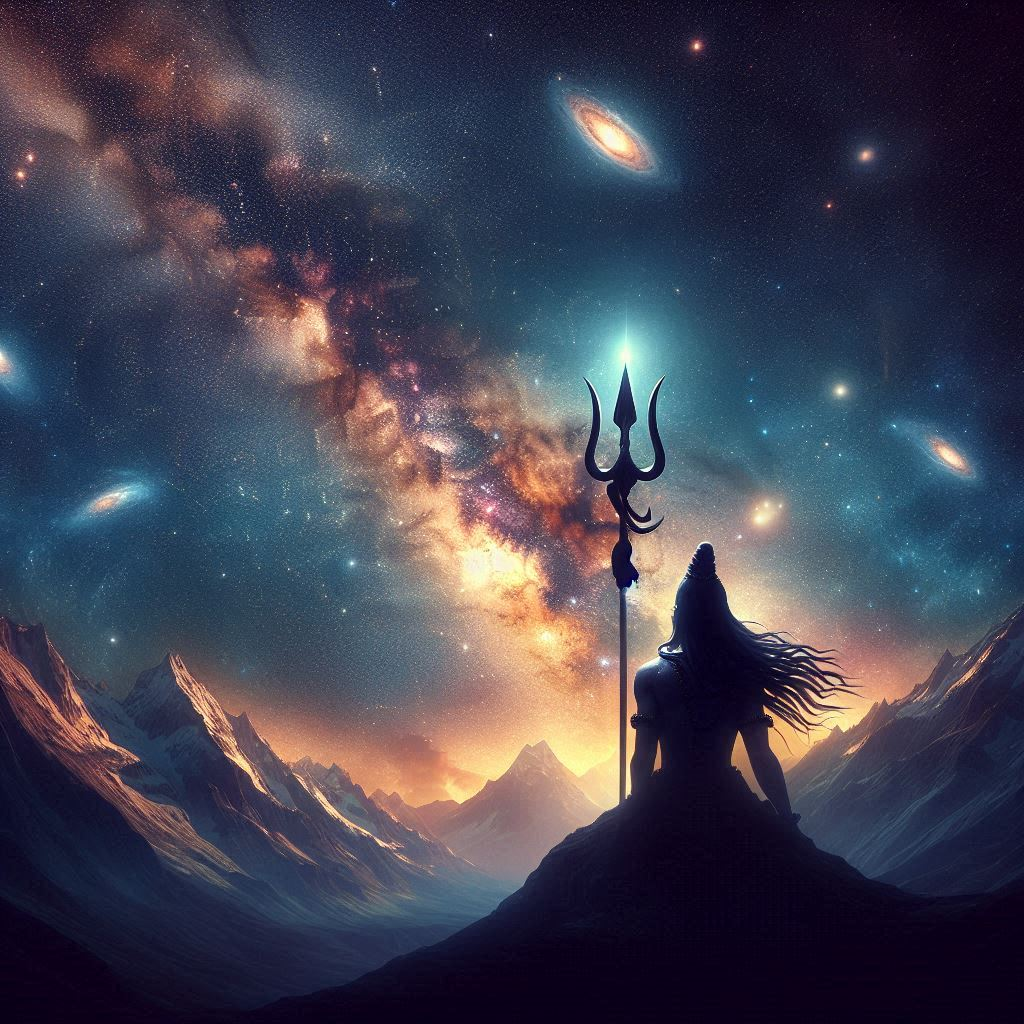
Shiva

अन्तर्ज्योतिर्बहिर्ज्योतिः प्रत्यग्ज्योतिः परात्परः ।
ज्योतिर्ज्योतिः स्वयंज्योतिरात्मज्योतीः शिवोऽस्म्यहम् ॥
antarjyotirbahirjyotih pratyakjyotih parAtparah
jyotirjyotih svayamjyotih Atmajyotih Sivo’smyaham
I am the auspicious one, the inner light and the outer light, the indwelling light, higher than the highest, the light of all lights, self-luminous, the light that is the Self. [1]
In the celestial realms, Brahma and Vishnu approached Lord Shiva with a question that had long puzzled them. “O great Shiva,” they asked, “what are the signs of the five divine acts such as creation?”
With a serene smile, Lord Shiva began to explain, “Understanding my duties is indeed profound, but I shall kindly share them with you. The signs of five divine acts are: creation (shristi), maintenance (sthiti), destruction (samhar), concealment (tirobhav), and grace (anugraha). These are my eternal tasks, always performed to perfection with pure discernment.”
He continued, “Creation is the birth of all things, nurtured by me. Maintenance is their preservation in a stable form. Destruction is their inevitable end. The movement of the soul is the act of concealment. Finally, grace is the liberation from all these cycles. These are my five tasks. The first four acts expand the world, while the fifth, grace, is the path to salvation. It is through grace that I remain in constant connections with everything.”
“My devotees see these five acts reflected in the five elements: earth, water, fire, wind, and sky. Creation,” he said, “is represented by the earth, from which all things are born. Water sustains life, fire transforms it, wind moves it, and the sky embraces it all. Sages and scholars must understand this.”
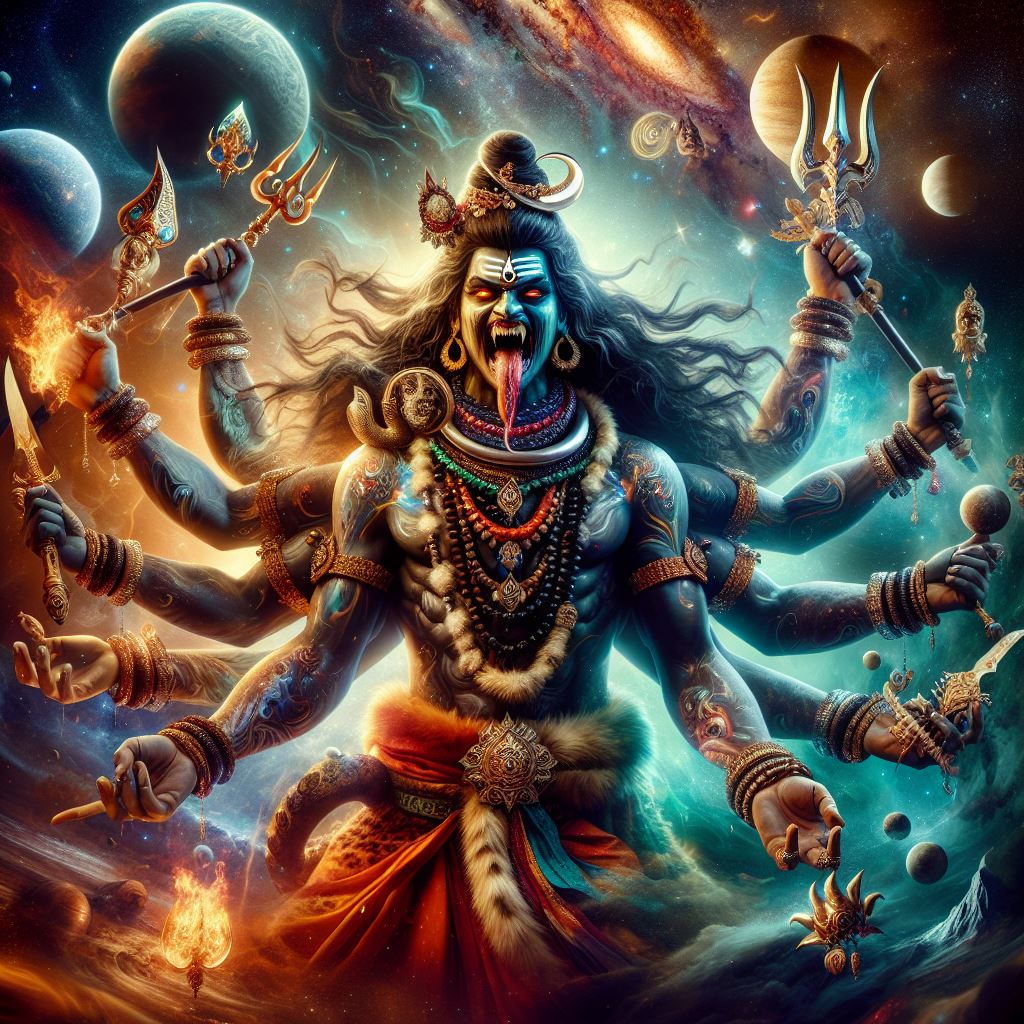
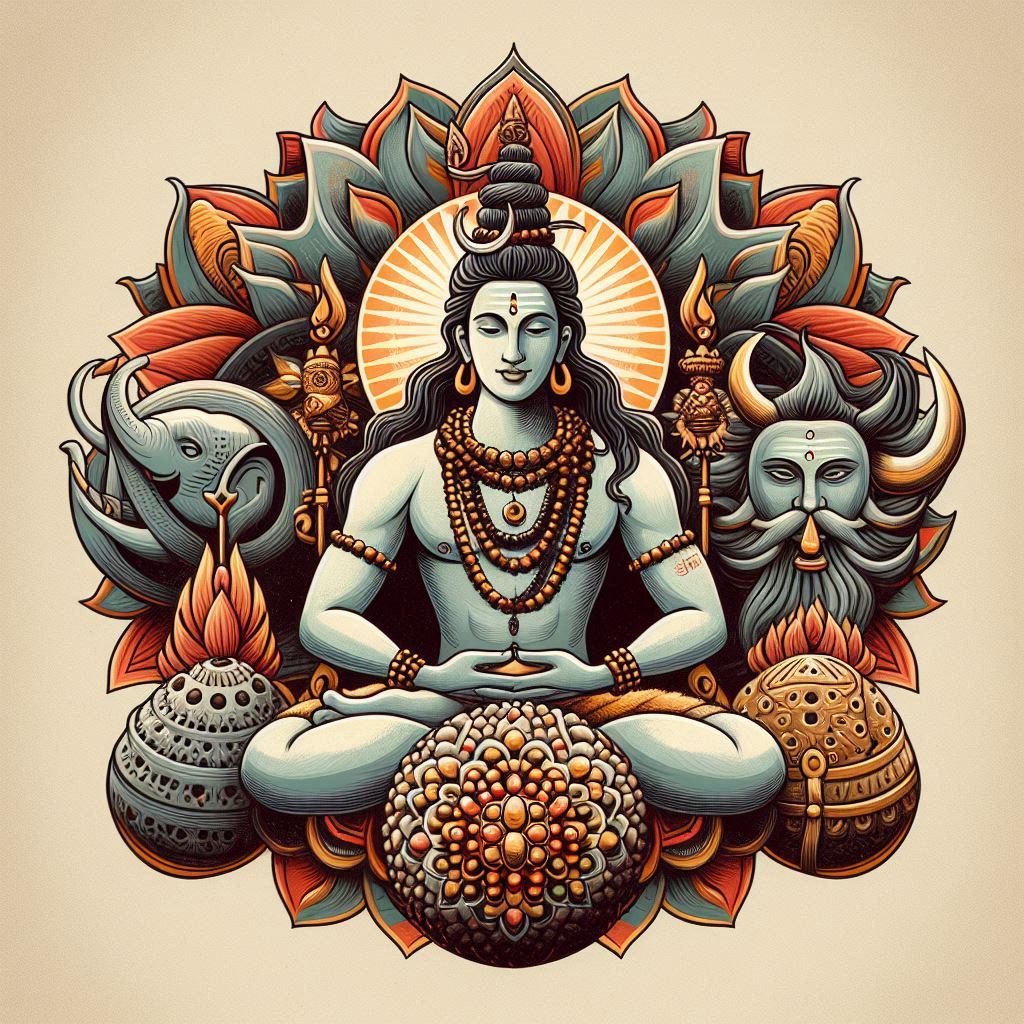
“To bear the burden of these five acts”, Shiva revealed his five faces, “I have four faces in the four directions and a fifth face in the center,” he explained. “Brahma and Vishnu, you have received two acts of grace from the divine: creation and maintenance. These acts are dear to you. Similarly, my incarnations Rudra and Mahesvara have received the tasks of destruction and transformation. However, the act of grace is unique to me alone.”
Shiva concluded, “Rudra and Mahesh have not forgotten their duties, and I have granted them equality with me. They are similar to me in form, dress, action, vehicle, posture, and armament.” [2]
Thus, Brahma and Vishnu gained a deeper understanding of the divine acts that govern the universe, each one a testament to Shiva’s boundless wisdom and grace. In his unfathomable forms (saguna) and formlessness (nirguna), Shiva embodies the essence of both existence (astitva) and non-existence (sunyata).

In the heart of the cosmos, where time and space intertwine, whose essence exemplifies the paradoxes of existence, which the mystical Rudraksha seed is associated with, and when in the full expression of grace, Shiva embodies the divine qualities of the non-dual Para-Brahman – that is free from illusion (Maya) and pervading everything and nothing in universe and beyond.
This is the story of Shiva, the Supreme Being in Shaivism, one of the principal traditions within Hinduism. Known by many names – Mahadeva, Shankara, Rudra, Bholenath – Shiva is the destroyer and the creator, the ascetic and the householder, the fierce and the benevolent.[3]
Shiva’s origins trace back to the Vedic deity Rudra, a fierce god associated with storms and the hunt. Over millennia, Rudra evolved into Shiva, a deity of profound complexity and depth. Ancient texts and scriptures chronicle this transformation, painting a vivid picture of Shiva’s multifaceted nature.
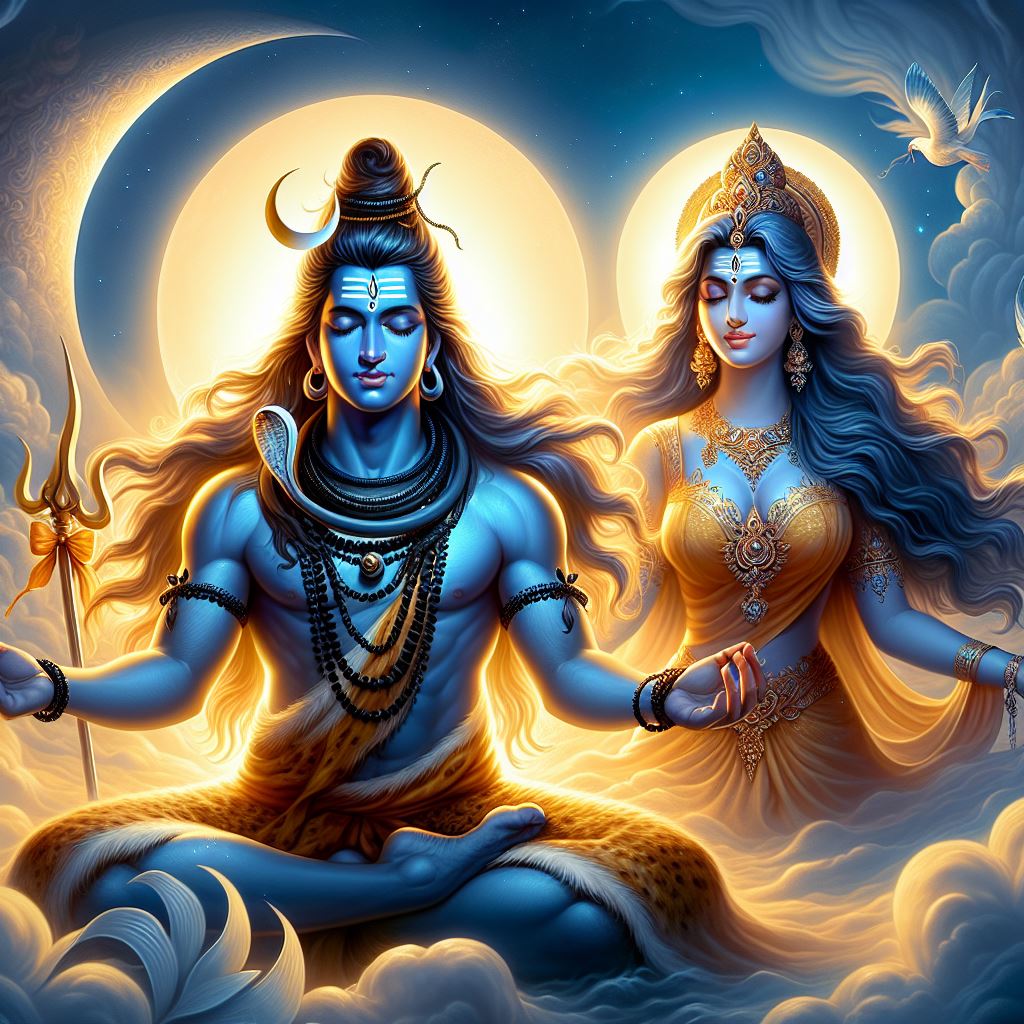
Among the myriad tales of Shiva, one of the most cherished is his union with Parvati, the daughter of the mountain king Himavan. Their marriage symbolizes the balance of male and female energies, a theme central to Shaivism. Parvati’s love and devotion softened Shiva’s fierce asceticism, creating a harmonious blend of strength and compassion.
Shiva’s role as the destroyer of evil is legendary. In the tale of his battle with the demon Andhaka, Shiva’s third eye, a symbol of his omniscience, plays a pivotal role. With a single glance, Shiva vanquishes Andhaka, restoring balance to the universe. This third eye, located in the center of his forehead, represents Shiva’s ability to see beyond the physical world, to perceive the truth hidden beneath the surface.
Shaivism, the tradition that venerates Shiva as the supreme deity, is one of the oldest and most influential schools of Hindu philosophy. It teaches the oneness of all existence and the interconnectedness of all beings. Central to Shaivism is the concept of Advaita, or non-dualism, which posits that the individual soul (Atman) is not separate from the ultimate reality (Brahman). This profound idea is encapsulated in the phrase “Shivoham,” meaning “I am Shiva.”
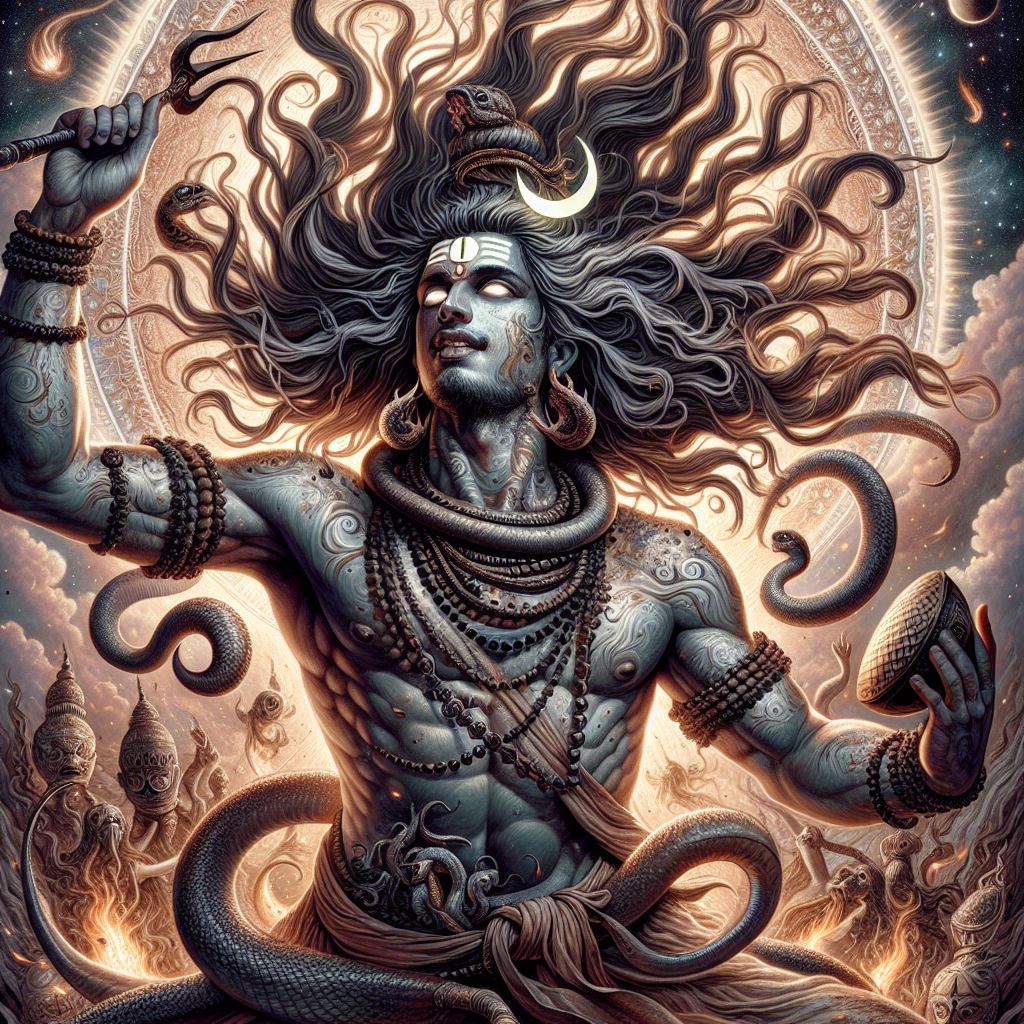
The universe, according to Shaivism, undergoes endless cycles of creation, preservation, and destruction, with Shiva at the helm of each phase. This cyclical process is beautifully symbolized by the cosmic dance of Shiva, known as the Tandava. In this dance, as Nataraja, Shiva creates, sustains, and ultimately destroys the universe, only to begin the cycle anew.
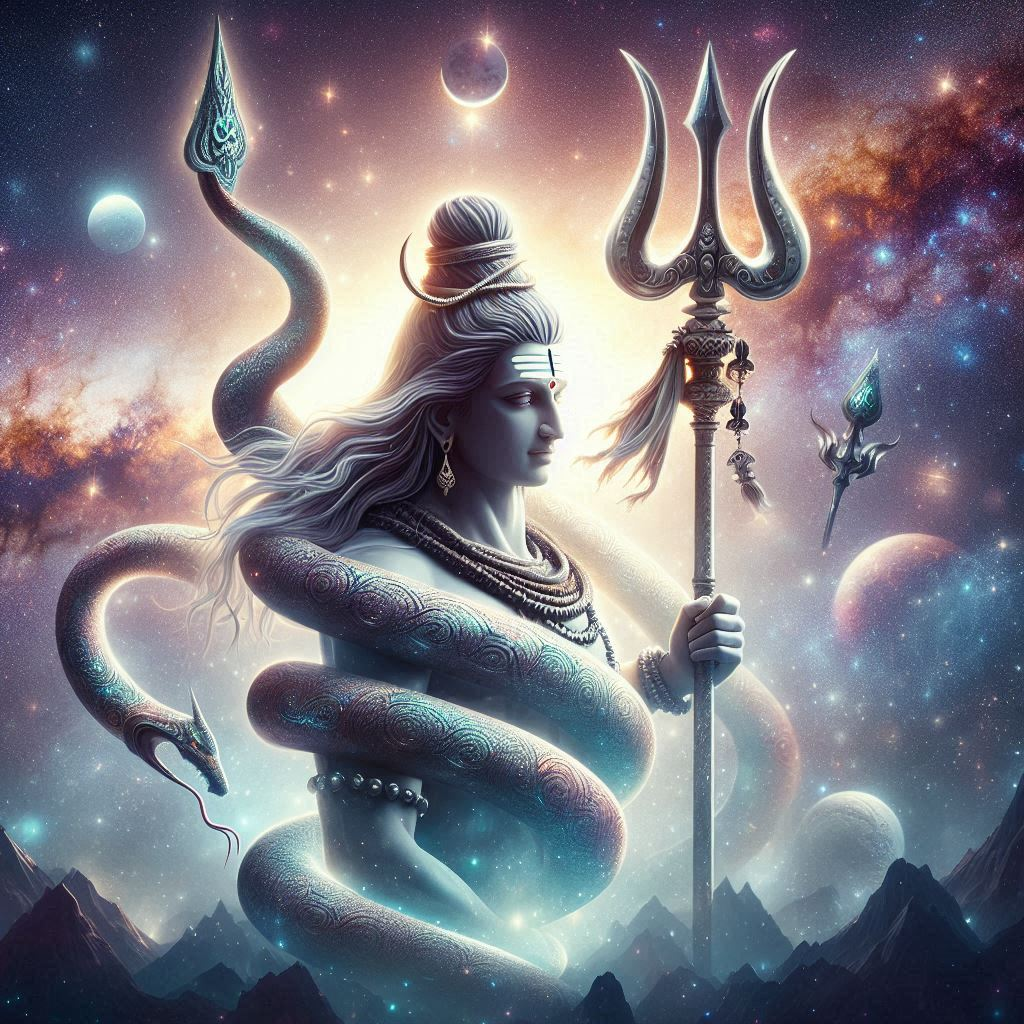
Shiva’s iconography is rich with symbolism. The Shiva Lingam, a phallic symbol, represents the creative power of the universe. Often depicted alongside the Yoni, a symbol of the feminine principle, it emphasizes the unity of male and female energies. The Trishula, or trident, with its three prongs, represents creation, preservation, and destruction. The serpent (basuki) around Shiva’s neck symbolizes his mastery over time and death.
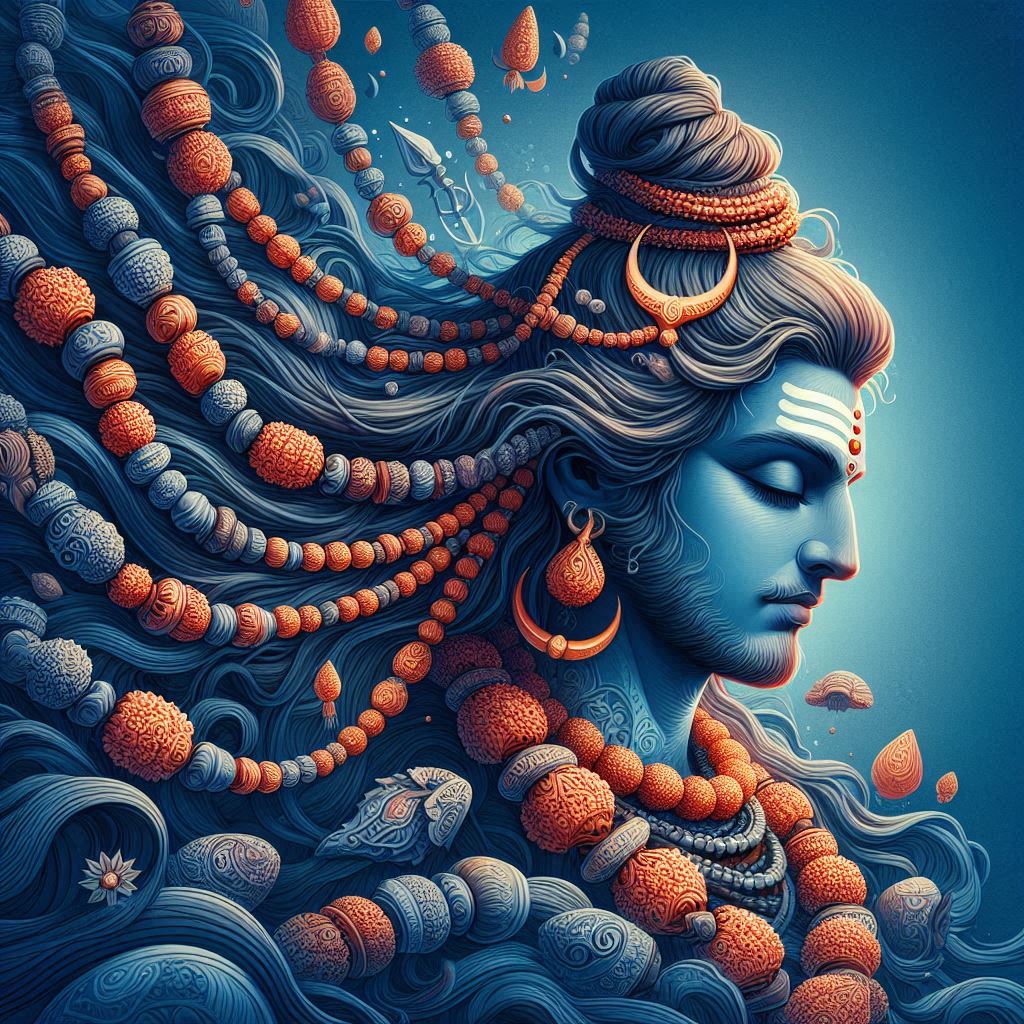
Additionally, Shiva’s third eye, located on his forehead, symbolizes his ability to see beyond the obvious and his power to destroy evil and ignorance. The crescent moon (Chandra) adorning his matted hair represents the cyclical nature of time and Shiva’s control over it. The river Ganga, flowing from his hair, signifies purification and the life-giving nature of water. The sacred ash (bhasma) smeared on his body signifies his asceticism and the transient nature of the physical world. The drum, or the Damaru, symbolizes the cosmic sound and the rhythm of the universe, while the Rudraksha beads he wears, represent meditation, peace, and control over the senses. Nandi, the bull, Shiva’s vehicle and companion, symbolizes strength, virility, and faithfulness. These attributes collectively portray Shiva as a deity who embodies both the destructive and regenerative aspects of the universe, reflecting his complex and multifaceted nature.
Devotees of Shiva engage in various practices to honor and connect with the deity. Chanting mantras like “Om Namah Shivaya” invokes Shiva’s presence and blessings. Meditation and yoga are integral to Shaivism, guiding practitioners toward a state of union with Shiva. Pilgrimages to sacred sites, such as the Amarnath Cave in Kashmir, Mount Kailash in Tibet, Pashupatinath in Kathmandu or the Kashi Vishwanath Temple in Varanasi, are journeys of devotion and spiritual awakening.
In contemporary Hinduism, Shiva remains a central figure, revered by millions. His teachings offer profound insights into the nature of existence and the path to spiritual fulfillment. In a world that is increasingly fast-paced and complex, the timeless wisdom of Shiva provides a sanctuary for those seeking deeper meaning and connection.
Shiva’s influence extends beyond religion, permeating various culture, art, music, and literature. While Shiva does not have a direct role or recognition in other religions, there are a few parallel symbolisms such as formlessness in Judaism, impermanence in Sikhism, the yogic nature in Sufism, spiritual rebirth in Christianity and transformation in Buddhism. His stories inspire and captivate, reminding us of the eternal dance of creation and destruction that underlies all existence, and in all dimensions. [4]
Shiva: The Primordial Stillness and Cosmic Source

Shiva, in the deepest metaphysical understanding, is not merely a deity adorned in myth and iconography. He is the very substratum of existence—the primordial stillness from which all things emerge and to which all things return. Unlike conventional personifications, Shiva transcends name, form, and identity. He is the infinite, formless void that underlies and permeates the universe.
This stillness is not simply the absence of sound or movement. It is the womb of all creation—the sacred silence from which the first vibration, the sound of Om, arises. In this context, Shiva is often described as shunyata, the cosmic emptiness that is not barren, but full of unmanifest potential. It is this field of pure awareness that gives birth to the dance of life, the play of form, light, and duality.
Symbolically, Shiva represents the axis of dissolution and regeneration. He is the destroyer not in a destructive sense, but as the force that clears away illusion, ego, and attachment. Just as a field must be cleared before new crops are planted, Shiva’s energy prepares the ground for spiritual rebirth. Through detachment, introspection, and inner silence, one comes closer to this essence—one begins to sense the vast stillness that is neither born nor does it die.
In yogic and tantric traditions, Shiva is also seen as the pure consciousness that witnesses all experience without becoming entangled in it. He is the unchanging seer behind the changing scenes of life. Meditation, particularly practices that focus on breath and awareness, are methods through which seekers align themselves with this Shiva principle. As the mind quiets, one begins to encounter the spaciousness that is not an external god but the eternal presence within.
Spiritually, Shiva is associated with the state of turiya, the fourth state of consciousness that is beyond waking, dreaming, and deep sleep. It is a state of pure presence and awareness, a deep inner stillness untouched by external circumstances. This is why meditative practices that bring us into silence, breath, and mindfulness are said to be doorways to Shiva’s realm. Yogis and mystics seek Shiva not as an external deity but as the silence within themselves—the unshakable witness behind all experience.
Interestingly, Shiva is also closely associated with the concept of time (Mahakala)—not as something linear, but as cyclical and eternal. The rhythms of the cosmos, the cycles of birth, life, death, and rebirth, all pulse within His field. To realize Shiva is to step beyond the illusion of time, to touch the timeless awareness that simply is.
Ultimately, to contemplate Shiva is to contemplate the very mystery of existence. He is the darkness that precedes the dawn, not as an absence of light, but as its source. He is the non-dual ground of being—neither this nor that, but that which makes both possible. In silence, in solitude, and in surrender, Shiva is found not as an external object of devotion, but as the original truth waiting patiently within all things.
Thus, Shiva’s significance is vast and multifaceted. The continuous transformation of consciousness (chit) to energy (prana) to matter (akash) and vice-versa is profoundly discerned by the attributes and experience of Shiva, embodying the paradoxical nature of the divine. His teachings and philosophy offer a beacon of wisdom and compassion, guiding seekers on their spiritual journey, and rudraksha is the most powerful tool one can wield on earth for enlightenment (jnana) and salvation (moksha). [5]
[1] Adi Sankaracharya. Brahma Jnanavali Mala, Verse 21. Translated by S. N. Sastri. Adi Shankaracharya (788–820 CE) was a revered Indian philosopher and theologian who consolidated the doctrine of Advaita Vedanta, a non-dualistic school of Hindu philosophy. Born in Kalady, Kerala, he traveled extensively across India, establishing four major mathas (monastic centers) to promote and preserve Vedic knowledge. His prolific writings include commentaries on the Upanishads, Bhagavad Gita, and Brahma Sutras, which remain foundational texts in Hindu philosophy. (Details in Chapter: Scriptures)
[2] Sharma, Kishan Lal. “Part 2. Shiva Upasana.” Ravana-Samhita (Asli Prachin), Manoj Publications, Delhi, 2008. Ravana is the antagonistic character in the epic “Ramayana”, authored by Rishi Valmiki. The epic explores themes of duty, righteousness, and devotion, performed by Rama and Sita. Ravana is considered one of highest knowledgeable being, in Hindu pantheon, who created the Shiva Tandava Stotra and Ravana-Samhita, and was well versed in the four vedas and six shastras. (Details in Chapter: Scriptures)
[3] There are one thousand and eight names of Shiva. Other Hindu deities with a thousand names are Vishnu (aka Narayan) and Adi-Shakti (aka Devi).
[4] The concept of multi-dimensional universe within a multi-dimensional universe is defined in the Rig Veda, Shiva Purana and many other scriptures. However, the 64-dimensional universes are defined in great depths in the concept of the Mahamaya in the Devi Bhagwatam, and Viswaroopa in the Srimad Bhagwatam.
[5] The significance of the Rudraksha is in great opus in “Section 1 Vidyesvara-Samhita Chapter 25 The Greatness of Rudraksha.” The Shiva Purana. (Details in Chapter: Scriptures)


No responses yet