Mystical Seed

In the ancient realms of the cosmos, the three cities of Tripura stood as a testament to the might and arrogance of their Asura (demon) rulers – Tarakaksha, Vidunmali and Kamalaksha. These cities, crafted by Mayasura from gold, silver, and iron, floated in the heavens, defying the gods and spreading chaos across the universe.
The Devas (gods), desperate to restore balance, turned to Shiva, the supreme destroyer, in his fierce form as Tripurantaka. With eyes blazing like molten lava and a heart resolute in purpose, Shiva mounted his celestial chariot, driven by the divine bull, Nandi. In his hands, he held a powerful bow, crafted by the Devas themselves, and an arrow imbued with the essence of destruction.
As Shiva approached the three cities, the heavens trembled, and the earth quaked. The Asuras, sensing their impending doom, unleashed their mightiest warriors and darkest sorceries. A fierce battle ensued, with Shiva’s arrows raining down like meteors, each one a harbinger of annihilation.
Despite the ferocity of the demons, Shiva’s resolve remained unshaken and performed the first cosmic dance – Tandava – in a display of fierce compassion. With a final, mighty effort, he drew his bowstring back; the arrow glowing with a transcendent light. Releasing it, the arrow soared through the sky, and within a moment, piercing the three cities in a single, devastating strike. The cities exploded in a cataclysmic burst of energy, their remnants scattering across the cosmos.
In the aftermath of this epoch battle, Shiva stood amidst the ruins, his heart swelling with a mix of triumph and sorrow. Overwhelmed by the magnitude of his deed, tears of both joy and grief welled up in his eyes. For Shiva, who holds both the Devas and the Asuras in equal regard, the victory was poignant. As these divine tears fell to the earth, they transformed into Rudraksha trees, each bead a symbol the eternal cycle of creation, sustenance, dissolution, obscuration and Shiva’s ultimate grace of salvation. [1]
Thus, the rudraksha trees came into being, a sacred reminder of Shiva’s power and benevolence, and a testament to the balance he restored to the universe.
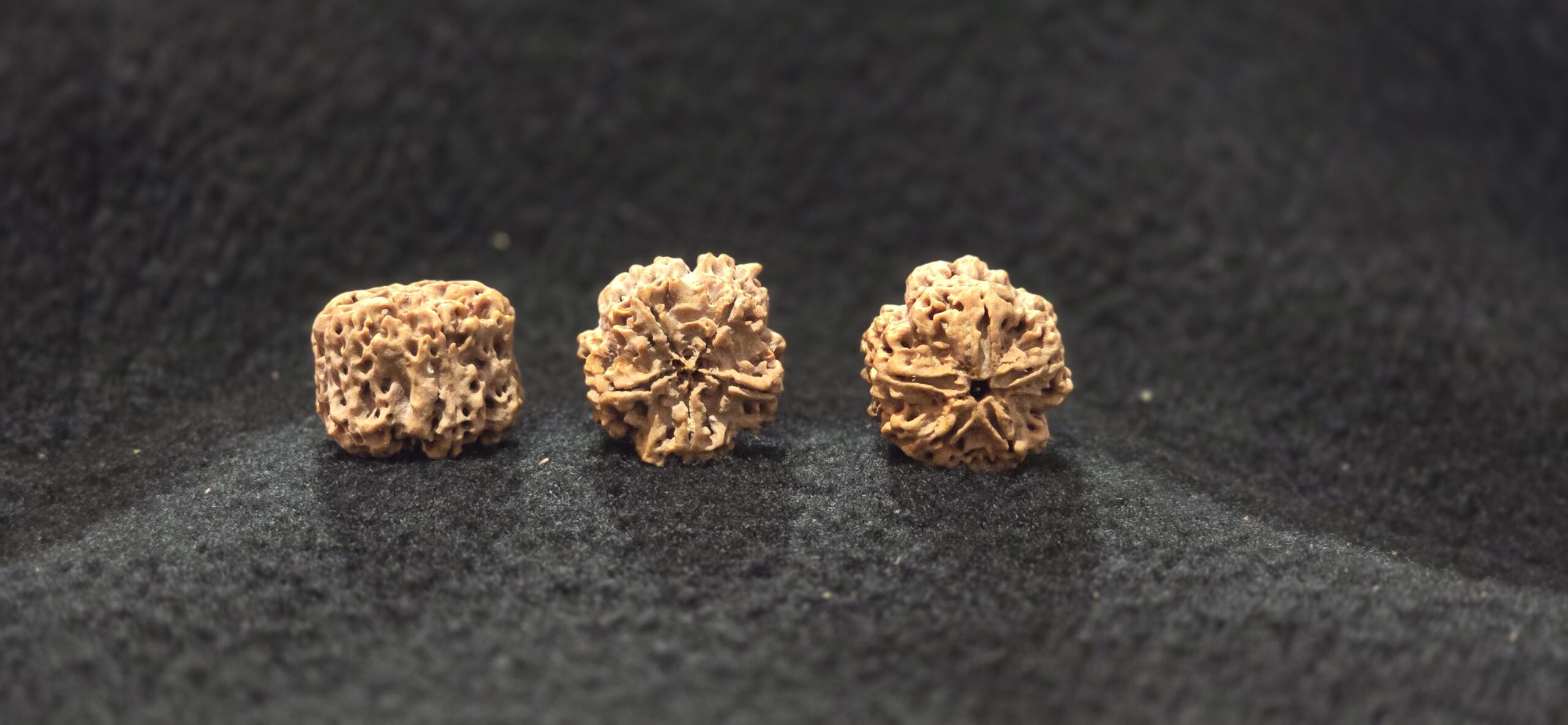
Rudraksha beads, derived from the fruit of the Elaeocarpus ganitrus tree, hold a revered place in spiritual and religious traditions, particularly within Hinduism and Buddhism. The term “Rudraksha” combines the Sanskrit words “Rudra” (a name for Lord Shiva) and “Aksha” (meaning eyes), symbolizing the tears shed by Shiva, making the bead a portion of the lord himself (shivansh) on earth, that one be face to face with and can adorn on their own body.
These beads are typically round with textured surface, characterized by the vertical lines or facets, known as “mukhi,” that run down their surface, ranging from 1 to 21, with each type of bead having unique properties and significance. The most common and widely used rudraksha beads are those with 5 mukhi, which are believed to represent the five elements (earth, water, fire, air, and ether) and are associated with general well-being and health.
The beads vary in size, color, and shape, depending on their origin. The most prized Rudraksha beads come from Nepal, known for their larger size and distinct mukhi. Indian and Indonesian Rudraksha beads are also popular, though they tend to be smaller and less defined in their facets.
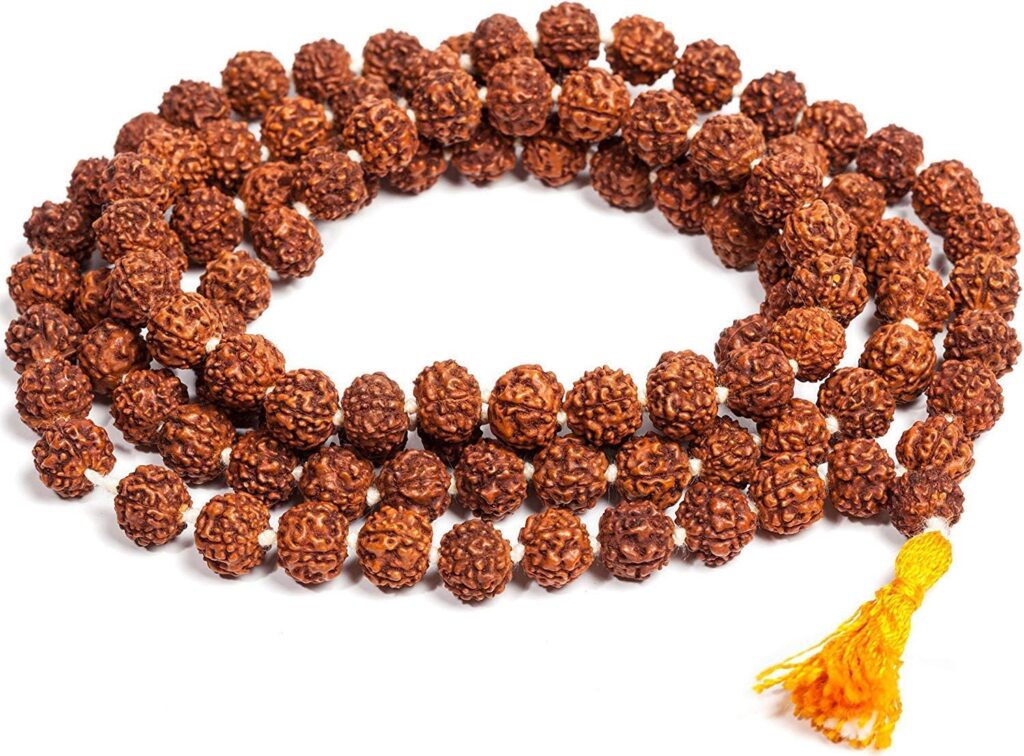
Rudraksha beads are revered for their spiritual, mental, and physical benefits. They are often used in the form of mala (prayer beads rosary) for chanting mantras, meditation, and other spiritual practices. A typical mala consists of 108 or 54 beads, a number considered sacred in many spiritual traditions. The beads are strung together with a larger bead, known as the “guru bead,” which signifies the starting and ending point of the mala.
The use of rudraksha beads is believed to bring a sense of peace, clarity, and focus to the mind. They are said to have a calming effect on the nervous system, reducing stress and anxiety. Additionally, rudraksha beads are thought to balance the body’s energy, promoting overall health and well-being.
In many culture, rudraksha beads are considered a powerful tool for spiritual growth and protection. They are often worn as necklaces, bracelets, or even carried as loose beads. Devotees believe that wearing rudraksha beads can protect them from negative energies, enhance their spiritual practices, and bring them closer to the divine.
Rudraksha beads are known to have electromagnetic properties that can influence the human body’s bioelectric field. Studies have shown that these beads can create a positive impact on the heart and nervous system, promoting a sense of calm and stability. The beads’ unique structure is believed to generate specific frequencies that resonate with the body’s energy centers, or chakras, aiding in physical and mental healing.
From a spiritual perspective, rudraksha beads are revered for their profound connection to divine energy. In many traditions, especially within Hinduism and Buddhism, they are believed to hold the blessings of Lord Shiva, who is often, depicted wearing them. These sacred seeds are said to enhance spiritual growth, inner peace, and clarity of mind, acting as a bridge between the earthly and the divine. Wearing or meditating with Rudraksha is thought to align one’s energy with higher vibrations, promoting a sense of protection, balance, and deeper connection to the universal consciousness. For centuries, spiritual seekers have used rudraksha to aid in their journey toward enlightenment and self-realization.
Rudraksha beads are not just spiritual symbols but also beautiful natural adornments. Their unique texture, with intricate ridges and natural earthy colors, gives them an aesthetic appeal that blends tradition with style. Often used in necklaces, bracelets, and earrings, Rudraksha can be combined with silver, gold, or gemstones to create elegant pieces of jewelry. Their natural simplicity complements both casual and formal attire, making them versatile accessories. Beyond their spiritual significance, rudraksha beads add a sense of authenticity and organic charm to personal fashion, allowing wearers to express both their spiritual journey and individual style.
Rudraksha market has seen steady growth due to its spiritual significance and increasing global demand. As more people seek holistic healing and spiritual wellness, rudraksha beads have become valuable commodities, particularly in countries like Nepal and India, where they are primarily harvested. The production and trade of rudraksha create livelihoods for many farmers, artisans, and traders involved in harvesting, processing, and crafting these beads into jewelry and spiritual items. With rising awareness of their cultural and spiritual value, rudraksha beads are also gaining popularity in international markets, contributing to the global trade of spiritual products. This growing demand has made the rudraksha industry a vital part of the economies of regions where these sacred seeds are naturally found, fostering both local and international business opportunities.
The mystical Rudraksha presents itself as a profound representation of cosmic balance, an absolute bestowment by the ultimate annihilator, to the mankind and all sentient beings. Moreover, Rudraksha is not only represented in the Hindu pantheon but also revered in various cultures and religions, allowing the bead to be omnipresent in its essence. The bead has been an economic boon to some of the most remote areas of the world, where the demand of the bead due to its spiritual, scientific and ornamental properties have culminated into uplifting the lives of the marginal people of the region. Rudraksha is a blessing and blesses all who adorns it.
[1] The mythology of the Destruction of Tripura is detailed in many scriptures, including the Shiv Puran, Padma Puran, Matsya Puran, Srimad Devi Bhagawatam and Skanda Puran. While some scriptures reference to drops of Shiva’s perspiration falling on earth from the heavens, the earliest reference of Shiva’s tears that formed the Rudraksha beads is found in the verses of Rudraksha-Jabala Upanishad of the Sama-veda. (Details in Chapter: Scriptures)
Featured products
-

4 Mukhi – Exquisite
$50.00 -
5 Mukhi – Exqusite
$50.00 -
Medium Common Mala
Original price was: $9.00.$7.00Current price is: $7.00. -
Small Common Mala
Original price was: $9.00.$7.00Current price is: $7.00. -
Tiny Knotted Mala
Original price was: $9.00.$7.00Current price is: $7.00.
No responses yet