
In the quiet forests of the Himalayas, the tears of Shiva fell upon the earth, giving birth to the sacred Rudraksha trees. These trees, cradling divine energy in their fruits, produced beads that would one day be revered by seekers of truth and spirituality. The name “Rudraksha” itself speaks of their origin—“Rudra” meaning Shiva, and “Aksha” meaning eyes. Each bead, a tangible fragment of the mighty god, carries with it a piece of Shiva’s essence.
As the mythology goes, the beads began to spread, passing through the hands of sages, monks, and spiritual travelers. Their round, textured surface, marked by the vertical lines known as “mukhi,” hinted at a mystery that was more than skin-deep. The five-mukhi Rudraksha, embodying the elements of earth, water, fire, air, and ether, became a favorite. These beads, larger and clearer from Nepal, were treasured for their purity. Smaller ones from India and Indonesia, though subtler in appearance, carried just as much power.
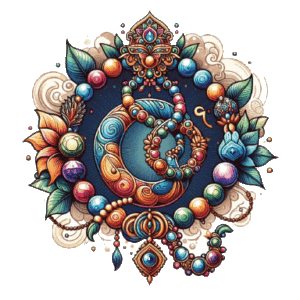
In ancient temples and quiet homes, these beads were strung together, 108 or 54 at a time, into malas. Each bead represented a step closer to enlightenment, a tool to calm the mind and bring clarity. The energy within them was said to harmonize with the body’s own, soothing the nervous system and protecting wearers from the chaos of the outside world. People found peace and focus in their presence, a sense of being shielded by something far greater than themselves.
For centuries, the Rudraksha has been more than just an object of devotion. It has bridged the gap between the earth and the divine, allowing spiritual seekers to touch the cosmos through their meditation and prayer. Those who wear them find their energies aligning with something universal, an invisible thread connecting them to the vast consciousness beyond. Whether worn around the neck, wrist, or simply held, these beads carry the power to uplift, protect, and transform.
As they passed from hand to hand, the demand for these mystical beads reached far corners of the world, bringing hope and prosperity to remote villages where the Rudraksha trees grew. The sacred beads not only carried spiritual blessings but became a source of livelihood, their beauty and power cherished across cultures.
And so, the Rudraksha remains a timeless gift from Shiva himself—a symbol of cosmic balance, divine energy, and protection. For those who adorn themselves with these sacred beads, the journey becomes one of spiritual growth and connection, a path that Shiva’s tears continue to guide with love and grace.
Rudraksha Mala by Divine Beads and Mala LLC
The trees of the beads of our Rudrâksa mala are from the Himalayan region of Nepal, at an altitude of over 800m. These beads are handpicked and individually selected for stringing, by the local artisans of Sankhuwasabha.
This Rudrâksa mala has been prepared in accordance with the ancient Scriptures, for the design, number of beads, and placement of the beads with mukhis (lines), seer (heads) and puchchhar (tails). The mala is bathed with clear and scented water, and afterwards quickly polished with ghee.
Use and Care
The mala must first be purified and sanctified by the wielder, before adorning oneself with.
- The scriptures have instructed to bathe the mala with Pañchagavya (cow-dung, cow urine, curd, milk, and ghee). However, one may choose to bathe the mala with clear water to begin the purification, or by simply sprinkling clear water over the mala.
- Sanctify the mala with condensed electrical charge of a Mantra, by placing the mala on the ground, and use the Mantra that you are familiar or comfortable with. If you do not have one, use the following mantra:
This mantra is one of the most revered and powerful mantras in Hinduism, dedicated to Lord Shiva. It means “I bow to Shiva,” symbolizing surrender to the supreme consciousness and inner self. Chanting it brings peace, purification, and spiritual awakening.
- Think of the great cause, Sîva and Bhagavatî have come on everything known and unknown, in all dimensions.
- Thus make the Samskâra (daily routine) of the mala Japam (constant awareness and repetitions of the mantra) and the desired end will be attained successfully.
- Worship the mala with the Mantra of that Devata (deity) for which it is intended.
- One is to wear the Rudrâksa rosary on one’s head, neck or ear and controlling oneself, one should make Japam with the rosary. On the neck, head, breast, or the ears or on the arms, the rosary should he held with the greatest devotion.
- It is highly meritorious and commendable to always hold the Rudrâksa, at all occasion.
Divine Beads and Mala Company
Broomfield, CO, USA
303-596-6670
divinemala2024@gmail.com
divinemala.com

Everything we know and we don’t know are all the same. We all came from the same and will return to the same in all forms of mind, body and soul. Aham Bramhasmi! Ta Tvam Asi! Peace to the Universe.
No responses yet